Spoiler alert! This piece contains plot details from “My Father’s Shadow.” It is a deeply personal reflection on grief, memory, and fatherhood through the lens of the acclaimed debut film.
I have a complex relationship with my father; the complexity being that he passed away in a car accident when I was nine years old. Before his passing, I would simply describe us as being attached at the hip. And so, his death is one of the most dizzying experiences of my life to date.
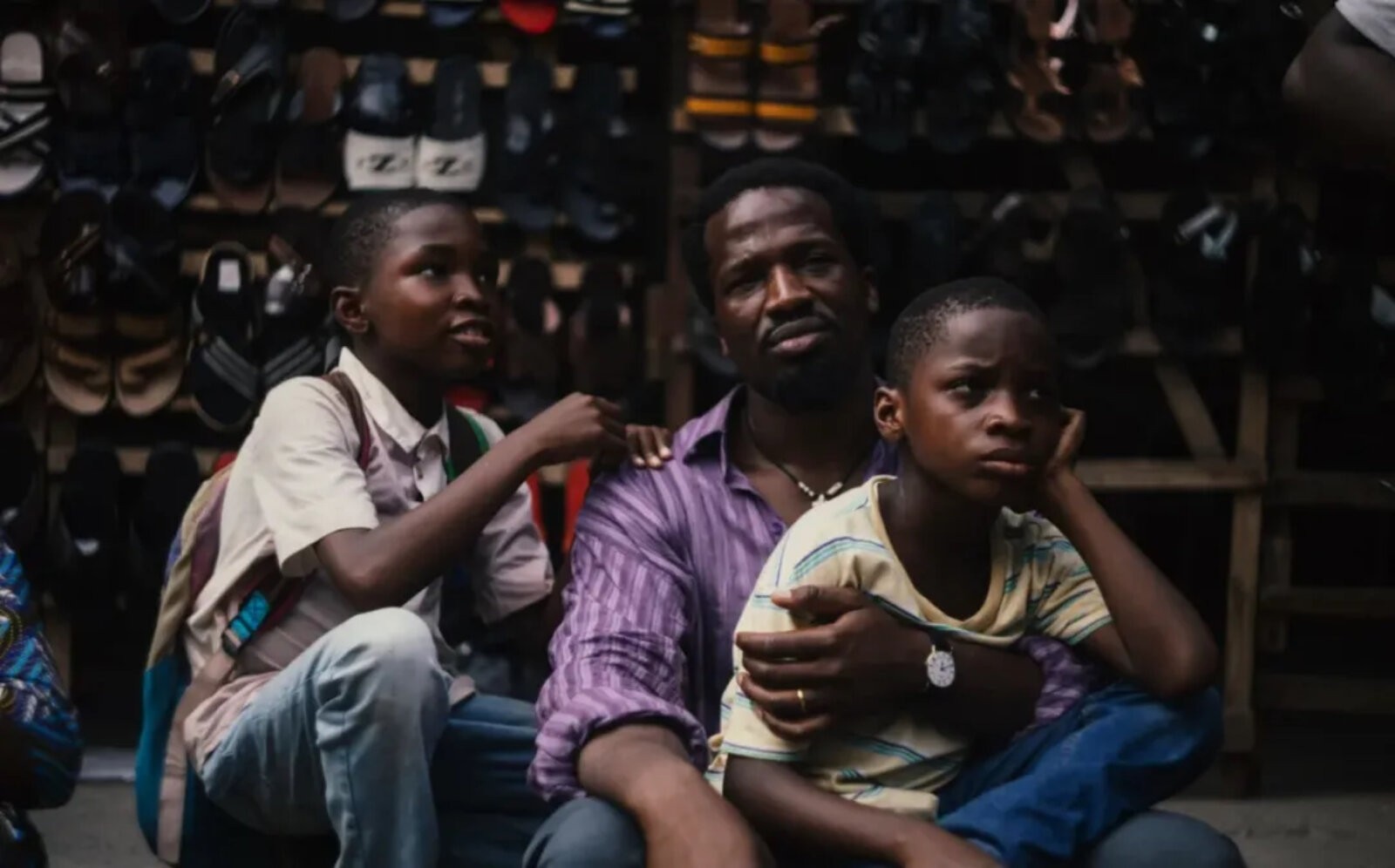
Watching “My Father’s Shadow”, the Caméra d’Or Special Mention winner, felt akin to walking into a familiar room and finding it to be completely transformed. Set in 1993 between Lagos and Ibadan, this lyrical debut follows two brothers, Remi and Akin, who unexpectedly accompany their father, Folarin, played by Ṣọpẹ́ Dìrísù, to Lagos to collect his long-overdue salary. It is directed by Akinola Davies Jr., written by Wale Davies, and produced by Funmbi Ogunbanwo.
This single, transformative day unfolds into a rich journey, highlighting significant explorations of memory, masculinity, and familial connection. For me, it was a beautiful and poignant meditation on grief. I felt as though each scene peeled back a layer in the infinite onion of grief surrounding my father’s sudden passing, much like Remi and Akin’s. This time, I am permitted to explore his death and our relationship in a profound new light.
The intimacy of memory
Our memories are often active reconstructions of past experiences, leaving considerable room for reinterpretation of events, either through the negotiation of emotions or perception. In this beautifully fallible way, I find memories to be truly intimate, as they are often what you and you alone perceive about the people and situations.
“My Father’s Shadow” is an intimate, meticulously crafted recollection of Remi and Akin’s last day with their father in this world. And much like memory, its cadence is beautifully flawed and inconsistent. Without giving too much away, as I believe that you should experience this film as wholly as you can, I am reminded of how similar my father’s last day with me was; full of activity.
My father passed away on May 28, 2008, a day after Children’s Day, and much like Remi and Akin, I too spent the day after school with my dad. We got ice cream, went to visit a few friends, and he dropped me off at home. He had one more errand to run; getting a new laptop for work. And so, he set out and let me know he would be back by 4:30… or was it 6:30? I cannot remember anymore. Needless to say, my father is not back from the laptop repair store, nor will he ever be.
In each frame, I am mesmerised by the rich, authentic details, some of my favourites being the Morgan’s pomade, glass Fanta bottles, and the women in matching skirts, blouses, and scarves as their everyday wear. It is in this detail that memory becomes beautifully flawed and inconsistent for me. I do not remember what hair cream my father used, if at all. I remember he preferred Coca-Cola to Fanta… or did he? My siblings and I have an evergreen argument, where they swear my father was a Chelsea fan, but I distinctly remember him in his final years, a die-hard Manchester United supporter. As you can imagine, they are Chelsea fans, and I am a Manchester United fan.
This is the very nature of memory; beautifully flawed and yet intimately profound. A chaotic and beautiful collage of moments, often coloured by our own perception. This does not mean that we must interrogate every single memory we have of our loved ones for their veracity. In fact, I think it presents the opportunity to lean into the emotions behind the memory; love, union, kindness, or whatever they may be. This is the true intimacy of memory — the recreation of a feeling previously shared with a loved one, details be damned.
A love rooted in presence and tenderness
In Nigerian and African societies, fathers who are tender in heart and expression are few and far between. Luckily for my siblings and me, my father was as tender as they came. This 6’5” German-Nigerian man’s days were filled with us. He taught me how to whistle, which ended with me being called a “palm-wine tapper” by my grade-school teacher. He taught me how to dance, and coached me from the sidelines while I participated in dancing competitions at kids’ parties.
And when I decided I wanted to learn how to cook, Indomie noodles just weren’t enough for my first rodeo. He guided me through the recipe for aglio e olio, a classic Italian delight of pasta, garlic, and olive oil. When he was tired, he would ask me to sing to him and play with his hair. He made me promise never to stop singing. In many ways, he was my first fan. And this is why several songs on my EP, Retrograde, are about him. I could go on and on.
This kind of devotion, this masculine tenderness that breaks stereotypes, is what makes Ṣọpẹ́ Dìrísù’s portrayal so moving. It reminds me that the most powerful fathers are often the gentlest, who always strive to be emotionally there for their children. Men like my father.
My father embodied both firmness and tenderness, teaching us to swim, play games, and taking us horseback riding. Since his passing, I haven’t been able to fully resurrect that love for horses, though polo still calls to something deep within me. As the film unfolded before me, It immediately transported me to the final days I spent with my father. The last day with a parent becomes a sacred place you revisit regularly. I am grateful that our final moments together were filled with love and laughter, before the abruptness of his passing. 17 years later, my siblings and I remain close, bonded in love, shared memories, and profound understanding of one another.
The beach scene where Remi asks if loving someone very much means not seeing them often cuts deep. My father, who would leave work early to breakdance with us, who prioritised presence over everything else, embodied what Davies rightfully says: that presence is as important as provision for fathers. Folarin’s tenderness as a father in the film reminds me that the memories which initially pain you when someone leaves are the very same ones that will comfort you later, carrying forward a love that transcends physical absence.
Read also: Nigerian films debuting at TIFF’s 50th edition remind us that our stories matter
When personal grief mirrors national mourning
“My Father’s Shadow” takes place within one of the most painful moments in Nigeria’s history. This was the year of the June 12 elections, when the military government under General Ibrahim Babangida annulled Chief MKO Abiola’s victory under the Social Democratic Party (SDP). The annulment dashed the nation’s hopes of democracy, a phenomenon that it would not experience until 1999. I was born in March of ‘99, and this is the first time it has ever come to mind that Nigeria was still under military rule at the time of my birth.
The film’s writer, Wale Davies, experienced military rule in Nigeria in his earlier years, and loosely weaves his personal memories of the period into Folarin and his family’s experiences. During the press screening at Filmhouse Oniru, Davies recalls the tangible tension in the air as a boy of 11 in 1993, at a time when the country felt like it was on a knife’s edge. He recounts the need to place leaves and branches atop windshields to get past military checkpoints on the way to and from school. This small act impresses the weight of collective grief directly into his childhood, showing how the national crisis wasn’t just abstract news, but a physical reality that shaped and skewed daily life, by instilling fear and restriction.
By embedding these subtle but profound memories, Davies makes a powerful argument: the individual and the political are not entirely separate. Instead, they are profoundly interwoven, with one echoing the other in a way that is both subtle and resonant. The boys’ search for a connection with their distant father then takes the metaphorical shape of a nation grappling with its own frustrated aspirations.
In 1993, many Nigerians felt orphaned by their own country, abandoned by the promise of democracy. Funmbi Ogunbanwo herself recalls that one of her earliest memories, and the first time she witnessed her father cry, was after this same annulment was announced. The film masterfully captures the intersection of individual and collective trauma, showing how the personal is always political. It underscores this point by exploring how people tried to make sense of absence in a nation that was also mourning the loss of the leadership it had chosen.
This exploration of collective grief and fractured hope resonates deeply because for many, the mourning of Nigeria has not quite ended. Through decades of terrorist attacks, insurgency, and political turmoil, the nation’s people sustained and shared this grief. Like Akin and Remi seeking their father, many of us hold our breath, unwilling to give up on the nation we believe in. At the same time, while catching glimpses of a future that is finally getting better.
Read also: Nigeria’s passport fee hike is turning the right to mobility into privilege
From one “junior” to another
Akinola Davies Jr., the film’s director, whose father passed away when he was only one, inherited not just his name, but a legacy pieced together by the memories of others. At the screening, he explains that he had felt like he had been living in his father’s shadow without his permission, simply by bearing his name. This is a kind of grief that takes on a profound weight — one in the shape of a person he never knew. Yet that presence remains a constant echo in his life. His anger came not from absence alone, but from an identity shaped by fragments and reinforced by others’ memories.
I, Denise, am a junior of sorts to my father, whose name was Dennis. And so, the film’s negotiation of identity reinforced by fragmented narratives and memories struck a very deep cord. I am simultaneously acutely similar yet awfully different from my father. And sometimes, it is not in ways I want to be, because I feel as though they, for lack of a better word, ‘taint’ the memories I have of him. The older I get, the more I realise that my father may have been exactly the father I needed, but he wasn’t always the husband my mother needed. This wasn’t because he was a man who was entirely good or entirely bad — and here I am, defending him again, as children of the departed often do — but because he was simply who he was. And sometimes, that person wasn’t what my mother needed.
This nuance of understanding carries through “My Father’s Shadow” in its presentation of Folarin. He is neither a saint nor a sinner, but a man whose absence and choices have created ripples that his children must navigate, just as my father has done with us. It captures a profound grief that lies not in the yearning for a person who has passed on, but in seeing them clearly, perhaps for the very first time. Between my lens of adoration for my father, and the more complicated figure I’ve been able to construct through understanding in my adult years, I am caught between who my father was, and who I hope he might’ve been. And I am acutely aware that my answer is neither black nor white because good people can do bad things, and bad people can do good things. Life is but a bouquet of nuances.
On the other hand, hearing Davies Jr.’s words made me want to probe deeper into this particular kind of grief, as someone I hold closest to my heart is also named after a father he neither knows nor remembers. For so long, I have been curious about how this might shape their identity, for better or for worse. Perhaps, I will summon the courage to ask.
A farewell suspended
My siblings and I did not attend our father’s burial. This was for fear that misguided relatives would whisk away us. There were many who thought that my mother, young and bereaved, could have a better life without us. We ended up spending the day at the home of our uncle Charlie, a cousin of my maternal grandmother. It was far away from any part of Port Harcourt – or Rivers state – we could recognise.
And while you ruminate on the lunacy and audacity of these misguided relatives, my grief here is that I feel as though I never truly got to say goodbye to my father. And without the closure of seeing his body lowered into the ground, I don’t know if I’ve truly said goodbye. 17 years later, that uncertainty remains. This lack of a tangible goodbye has left me in a peculiar kind of limbo. I have existed in the space between a life once filled with his presence, and a life that has continued without him. A farewell that feels unfinished holds together both.
This is exactly why the final scene of the film, depicting Folarin’s body being carried away, felt like a devastating blow to the chest. My tears ran freely, not just for Akin, Remi, and Bola, but for a memory I carry of my own mother, who fainted in grief several times after my father died. For my mother, whose hands I could not hold, whether as her first daughter or child, as my father, her husband, made his way back to the earth. For my siblings and I, with farewells suspended in time.
I have since visited his grave, but it was over a year after he passed, when we returned to Port Harcourt, after being away, in the interest of our safety. It felt like being at the grave of someone I loved but was unsure I knew. I felt like an outsider to my own grief. I had missed a time so crucial that it prevented me from ever fully grasping the finality of his departure.
Sporadically, I see him in my dreams. I can no longer hear his voice, but I can hear his laughter. Sometimes, I think I can because it is a deeper version of mine. And sometimes, when we see each other in my dreams, we embrace and laugh in unison. Other times, he leaves messages for my mother, as she vehemently refuses to involve herself with necromancy of any kind, even if the spirit in question is that of her late husband. It makes me giggle sometimes. In fact, I am giggling right now.
The generosity of legacy
In the years that followed my father’s passing, I began to feel the weight of a responsibility to keep him alive. I tried to do so through art, writing, or simply by speaking about him. In my family, we remember our dead. We celebrate their birthdays, anniversaries, and any notable dates, long after they have passed away. This familial veneration in love runs deep for us. And it’s exactly why tears brimmed in my eyes when Folarin shared with Remi that he was named after his uncle, Folarin’s brother who had passed away at sea. Remi, Folarin’s brother, was sad that he had been forgotten, and could not find peace. At that moment, I was thankful to be named after my father, whose memory I am able to keep vigil on daily.
“My Father’s Shadow” suggests something generous about remembering our dead. That we can honour our dead not by perfecting them in memory, but by allowing them to be human, flawed, and ultimately, enough. The film’s refusal to idealise its patriarch is a powerful example of this truth.
Perhaps what moved me most about “My Father’s Shadow” is what Davies Jr. described as creating “in the spirit of generosity” as the film is rife with symbolism. But hey, if you get it, you do, and if you don’t, that’s okay too. This generosity extends to how we remember our dead, how we tell their stories, and ultimately, how we allow ourselves to grieve and heal and continue.
The really mundane things are what carry us forward. Not the grand gestures or dramatic moments, but the everyday details: the way light fell through a window, the sound of laughter, the memory of hands that once held us. The film understands this, weaving grief, memory, nostalgia, and love into something that feels both achingly specific and beautifully universal.
Read also: Reclaiming their legacy: 12 Nigerian women history almost erased
Finding light in the shadow
In the end, we all live in someone’s shadow. It is cast by our parents, ancestors, the people who shaped us before we knew we were being shaped. The question isn’t how to escape those shadows, but how to honour them whilst still finding our own light. The film suggests that perhaps the answer lies in honesty. In allowing our complicated love for imperfect people to exist without resolution, without neat endings.
I have decided to give myself the closure I need around my father in whatever way I can while I am here. And it is because of achingly beautiful pieces of art like “My Father’s Shadow”. They remind me that some stories continue long after their apparent end.
In the space between memory and myth, between the father I knew and the man he was, I’m learning to live not just in his shadow, but in the light that shadow makes possible.
My middle name, Loliaba, means “star”, so I know that he would want me where I shine at my brightest.
I love you, my Daddy. And I miss you even more.
Read more: The first time I felt pretty