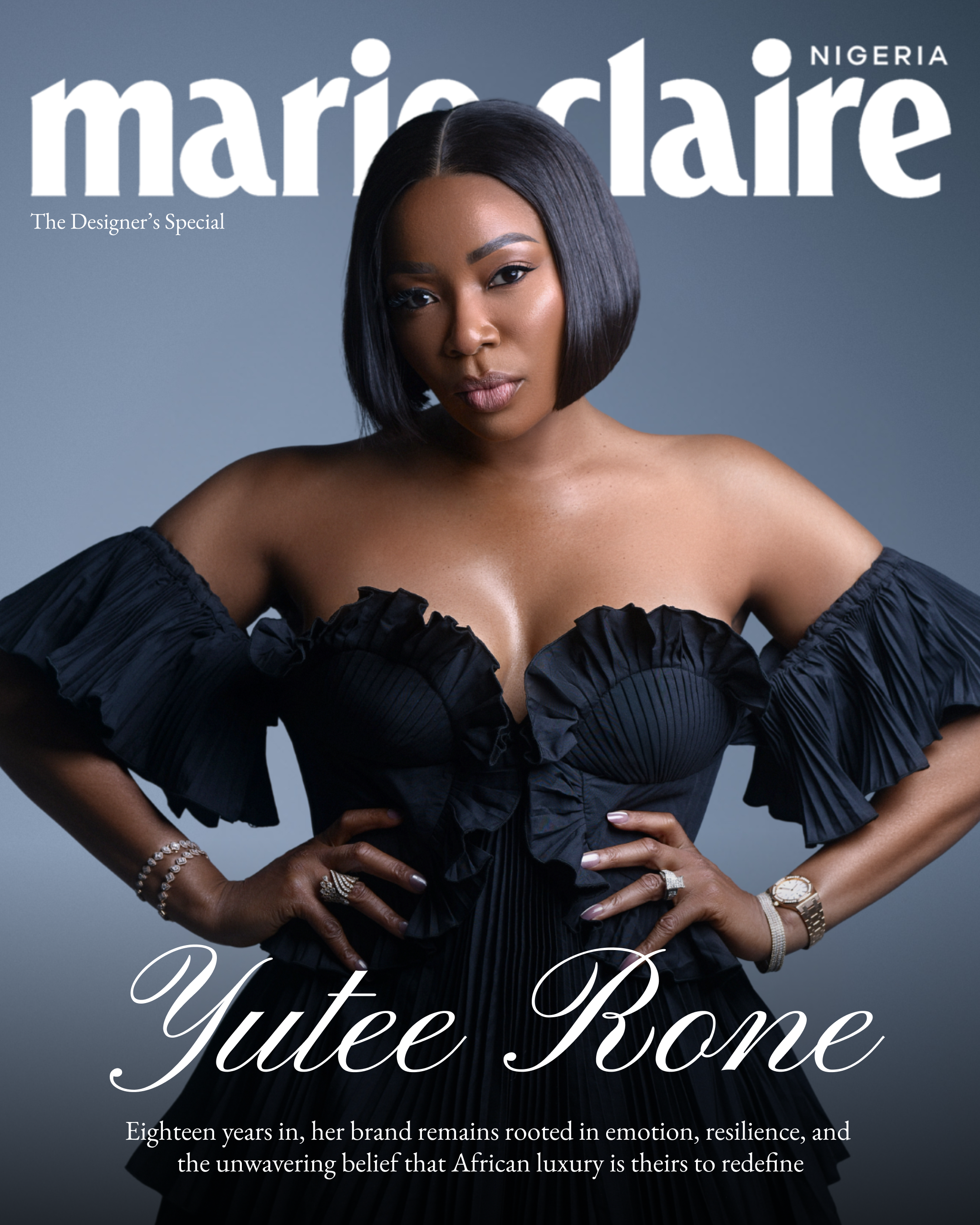
Odio Oseni, founder of Odio Mimonet, reflects on the milestones, the Lagos-rooted inspirations, the pivotal choices, and the soul work that shaped the brand into a cultural institution.
In an industry where trends evolve at breakneck speed and designers often bend to the demands of virality, standing firmly in one’s ethos is rare. Building an empire out of that ethos is even rarer. Yet for thirty years, Odio Oseni, creative director and founder of Odio Mimonet, has done that. “I’m always looking for that piece that will change the zeitgeist,” Odio Oseni says.
Three decades after she began stitching dreams in a small backroom in Lagos with one staff member and a heart full of conviction, Odio Mimonet has become one of Nigeria’s most respected fashion houses. The brand is known for its couture mastery, textured storytelling, and a dedication to the Nigerian woman. The brand predates social media and most renowned fashion events in the nation, including Lagos Fashion Week. The brand has been both witness to—and architect of—the evolution of contemporary Nigerian fashion.
In this exclusive interview, as the brand celebrates its 30th anniversary, Oseni takes us on a journey through the years of Odio Mimonet. From its inception to its anniversary fashion show, an insight into the craft, a universe of quiet rigour, cultural depth, and enduring femininity.
The anniversary collection: The city that lives within her work
When Oseni speaks about her latest collection, Ambience, her voice is filled with a familiar tenderness. Lagos, she says, remains her favourite city in the world, and the collection is an ode to its chaos, colour, memory, and music.

“I’m influenced by everything around me,” she says. “The bustle, the noise, the smells, the sights — we take them for granted, but they go into our subconscious.”
On the runway, Lagos appeared in motifs drawn from old Nigerian currency notes, in the red of Igbo caps, in the curved lines of drums, and in the subtle nods to hairstyles reminiscent of the ’60s and ’70s. Even the shoes carried confetti-like embellishments and “fragile” tape—symbolic of the city’s toughness, wrapped delicately around its vulnerabilities.
“We try to be beyond trends,” Oseni explains. “For each collection, I hibernate. I shut out the world so I can tell my story in its purest form.”
The story always ends the same way: With a moment in the process when, as she describes it, “the dots connect.” The moment when what she imagines aligns with what she creates, and with what her audience feels.
“That connection is the rush I work for,” she says. If she doesn’t feel the connection, the collection won’t make it to the runway. This is her current approach, but it wasn’t always this way.
The beginning of Odio Mimonet: A backroom in Lagos
It’s hard to imagine now: The founder of a revered Nigerian fashion label once choosing a tiny room in her Lagos home over a leadership role in a European factory. But Oseni knew that building something meaningful required starting from the ground up.
She insisted on beginning her journey in Nigeria, where she worked closely with artisans who would eventually become “like brothers,” learning alongside them, bridging gaps in skill, worldview, and expectation.
“I earned life skills in those early years,” she says. “I wouldn’t exchange that for anything.”
Fresh out of fashion school in the UK, she returned home with a dream that seemed unconventional at the time. “In the 90s, Fashion wasn’t fashionable in Nigeria,” she recalls with a soft laugh. “People would ask, ‘What are you really studying?’”
Oseni witnessed the transformation of Nigerian fashion from the early years of scepticism toward “Made in Nigeria” to an era where diaspora communities fly home in December with empty suitcases ready to shop with local designers.
She speaks of a renewed pride in culture, craftsmanship, and storytelling — coupled with the democratising force of technology, which allows Nigerian designers to reach global audiences instantly.
“The greatest shift is the decolonisation of our minds,” she says, “We now understand our talents can match anything in the world.”
Read also: Beyond the runway: How Lagos Fashion Week is powering Nigeria’s creative economy
Odio Mimonet before digital media: Building a couture following from a backroom
Before Instagram drives, fashion week spotlights, or digital lookbooks, Odio Mimonet was a private, deeply bespoke couture operation. Oseni didn’t even take photos of her early pieces.
“I made unique pieces only,” she says. “When someone would ask for what another woman wore, I’d say, ‘No—I only make one-of-one.’”
For nearly a decade, she created custom garments tailored exclusively to individual clients. Only later, after countless women asked, “Do you have something I can quickly pick up?”, did Oseni create her ready-to-wear line, Voyage by OM.
“Voyage was my way of saying, ‘Take a journey with me,’” she explains.
Years later came another evolution: Mimi—a diffusion line. Yet even with ready-to-wear in the mix, her beliefs remained intact: No mass production, no dilution of identity.
“Our ready-to-wear pieces are still not mass-made,” she says. “They’re not bland. They still carry our quirk.”
The art of innovation: When culture meets couture
One of her proudest recent pieces is a slanted, side-draped agbada-inspired silhouette that reimagines traditional menswear into a contemporary women’s form.
“It’s still our culture,” she says. “But it’s twisted into something new. That’s the beauty.”
Culture has always been dear to Oseni. She explains that the name Odio Mimonet is a layered reflection of identity, legacy, and artistic intention. “Odio” draws from her Benin heritage and anchors her to her origins, while “Mimonet”, inspired by the impressionist painter, Monet, represents elegance, refinement, and the modern woman she designs for. Together, the two names became a declaration of her creative perspective, a fusion of tradition and sophistication that frames every piece she creates.
She predicts it will inspire a new era of designers to explore similar reinterpretations, something she welcomes.
“A brilliant piece changes how people see things,” she expresses. With a mind so detailed and creative, it is an enigma how Oseni has managed to curate and retain her audience over the years, in a country that once
The Odio Woman: A woman who defines the trend, not chasing it
As Nigeria’s fashion landscape broadened, so did her audience. The Odio woman, once a tight circle of older, affluent clients, has expanded across generations.
“Younger women aspire to the brand now,” she says. “But the ethos remains the same. The Odio woman is strong, cultured, well-travelled, a global citizen who understands textures, craftsmanship, and stories.”
Her designs reflect that woman, through their structured silhouettes, layered textures, bold yet intentional colours, and the subtle infusion of heritage into modern form.
Every piece is deliberate. Every collection is a narrative.
What’s next after 30 years?
With thirty years behind her, Oseni sees the future as an extension of the same discipline and curiosity that carried her from that small backroom to a fashion house with enduring cultural impact.
Her next chapter? More storytelling. More innovation. More Lagos. More art on the body.
She is devoted to showing the world what the Nigerian woman looks like — how she moves, how she loves colour, how she carries culture effortlessly across continents.
She remains humbled by the women who have worn her pieces for three decades, some still returning with gowns she created decades ago.
“That,” Oseni says, “is the greatest reward.”
Read more: Christmas gift guide for the always-on fashion it-girl